

Material Issues (Materiality)
Process for Identifying Material Issues (Materiality)
The Daiei Kankyo Group listed environmental, social, and business challenges it faces. Through a selection process applying the concept of double materiality to assess the importance of each issue, five material issues (materiality) were identified in June 2024. We also outlined the components of each issue and the rationale for their selection as material.
The Daiei Kankyo Group’s Material Issues (Materiality)
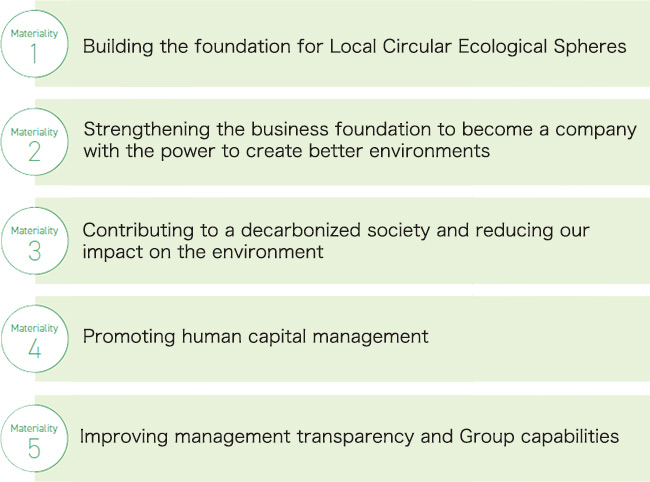
| Material Issues | Components | Stories | |
|---|---|---|---|
| 1 | Building the foundation for Local Circular Ecological Spheres | Living in harmony with local residents and contributing to local communities | Waste management and recycling, the core business of the Daiei Kankyo Group, is a business that cannot succeed without understanding from local communities. We have always operated businesses rooted in local communities. It is undoubtedly important to become more rooted in the local areas where we currently have business locations. As we expand our business area in the future, it is also extremely important to develop strong trust with local communities in new areas, just as we have in our existing locations. We will continue to build the base for creating Local Circular Ecological Spheres aimed at generating multifaceted value through various means of communication with local communities. |
| Expanding our system of cooperation with municipalities | |||
| 2 | Strengthening the business foundation to become a company with the power to create better environments | Promoting integrated treatment of general waste and industrial waste | While it is necessary to centralize management facilities in the waste management and recycling area to achieve carbon neutrality by 2050, we think depopulation and financial issues will make it hard for municipalities to upgrade waste management facilities on their own. The Daiei Kankyo Group will work to centralize management facilities and contribute to the simultaneous achievement of carbon neutrality and relief of cost burden on waste generators in this area by integrated treatment of general waste and industrial waste at all our locations, as well as working on the expansion of general waste management at existing locations and the creation of new business locations, mainly through public-private partnerships. |
| Strengthening the capacity of treatment facilities and expanding the waste management network | |||
| 3 | Contributing to a decarbonized society and reducing our impact on the environment | Advancing resource recycling systems | To achieve carbon neutrality for Japan by 2050, it is extremely important for each industry to recycle and use untapped resources that have been disposed of as waste up to the present. We will advance resource recycling systems to maximize recycling use while also generating resources and energy from waste to the greatest extent possible and achieving energy savings in facilities. In addition, we will endeavor to reduce the impact of waste processing on the surrounding environment as much as possible, and disclose the status of its maintenance and management in easily understandable terms, so the public appreciates the fact that we are operating facilities in a safe and secure manner. |
| Promoting electricity generation and energy conservation | |||
| Tackling environmental protection | |||
| 4 | Promoting human capital management | Developing the next generation of leaders | Whether the Daiei Kankyo Group can meet the expectations from communities, customers, and shareholders and earn their trust depends entirely on our people. We will develop human resources who can keep up with the rapid growth and changes in society, put the commitment to our management philosophy—creation, innovation, and meeting challenges—into practice, and will boldly take on challenges even seemed impossible. We will also continue to improve engagement to enable all employees to demonstrate their individuality and capabilities and work energetically with high motivation. Furthermore, we will establish an environment that will make it possible to continue to recruit, find, and develop outstanding human resources in the Daiei Kankyo Group’s business areas where industry restructuring is likely to take place in the future. |
| Recruiting, finding, and developing human resources | |||
| Establishing the foundation for a comfortable work environment and diversity | |||
| 5 | Improving management transparency and Group capabilities | Strengthening Group governance | From the perspective of the Daiei Kankyo Group, the greatest reason for listing was to strengthen governance. That is because the establishment of a Group governance system was necessary, given the expansion in the number of subsidiaries and employees. As we take the lead on pursuing industry consolidation, we will improve management transparency and the collective strengths of the Group by transitioning to a company with an audit and supervisory committee and reinforcing information security, occupational safety and health, and other management systems to further enhance governance. |
| Ensuring thorough corporate ethics and compliance | |||
| Strengthening information security | |||
| Ensuring occupational safety and health | |||
Process for Identifying Material Issues (Materiality)
Step 1 Created Long List → Extracted Issues (January 2024)
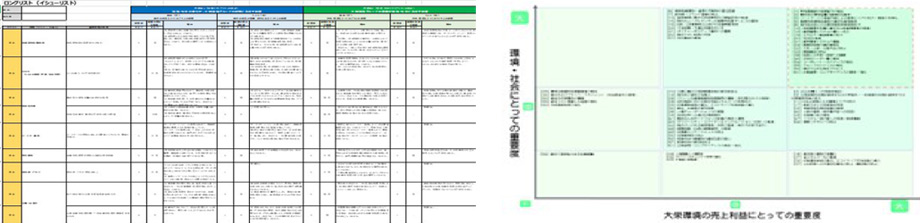
Based on our ESG policies and consultation of the Sustainability Accounting Standards Board (SASB) standards, Global Reporting Initiative (GRI) standards, and other guidelines, we created a long list enumerating Daiei Kankyo Group issues and environmental and social issues. We extracted 64 issues.
Step 2 Evaluated by Scoring and Narrowed Down Candidates for Material Issues (March to April 2024)
A cross-organizational team consisting of members selected from internal departments and Group companies scored the 64 issues from the perspective of double materiality for evaluation. The team then narrowed high scoring issues down to 15 as candidates.
Step 3 Validation (Reviewed by Officers and Experts) (May 2024)
Officers reviewed the material issue candidates. They also solicited comments from external experts and verified the appropriateness. The Sustainability Promotion Committee deliberated and made adjustments based on the opinions from these officers and experts.
Opinions on Identification of Material Issues (Representative Examples)
From Expert A
The compatibility of the material issues with the corporate vision on becoming a company with the power to create better environments should be carefully considered. I also think that material issues relating to the environment are particularly essential among issues regarding sustainability, so too much emphasis is not placed on business areas.
From Expert B
In the case of the double materiality approach, it is not always necessary to score high both on financial impact on the Company and social and environmental impact. Occupational safety and health should be essential, given the specific characteristics of the business. While it is necessary to reflect the opinions of stakeholders to the extent possible, a point of caution is that an average score is not always appropriate due to the diversity of the business. It is also good to have wording emblematic of Daiei Kankyo.
From an Executive Officer
When I looked at the wording of “ensuring proper waste disposal,” used for one of the material issue candidates in Step 2, I thought that it could certainly cause the misunderstanding that there is some improper disposal within the Group. I felt the revision to “strengthening the capacity of treatment facilities and expanding the waste management network” in the final proposal in Step 4 made it easier to understand our intent.
Step 4 Decision Made by Management (June 2024)
The final proposal, which contains five material issues, the components of the material issues, and the stories, was approved by the Board of Directors.
Action Plan and KPIs
In May 2025, we formulated and published an action plan aligned with our Medium-Term Management Plan, D-Plan
2028. In June, we established key performance indicators (KPIs) corresponding to this action plan.
These initiatives aim to achieve both the Group’s sustainable growth and the realization of a sustainable
society.
The target timelines for achieving the KPIs are set for the fiscal years ending March 31, 2028, and March 31,
2031, with some extending beyond the fiscal year ending March 31, 2032. Progress will be monitored accordingly.
| Materiality | Components | Action plan | KPIs | Target values for FY2028/3 (D-Plan 2028 period) |
Progress for FY2026/3 |
(Reference) Target achievement timelinesset for FY2028/3 onward |
|---|---|---|---|---|---|---|
| 1. Building the foundation for Local Circular Ecological Spheres | Living in harmony with and contributing to local communities | 1. Appropriately disclose information to stakeholders |
(Qualitative target) Ongoing enhancement | - | News releases 147 (in Japanese only) (News: 96, IR news: 51) Notice regarding support for the August 2025 heavy rainfall disaster in Kirishima City, Kagoshima Prefecture Maintenance and management information related to waste management facilities (published monthly) |
- |
| 2. Support the development of local communities and the promotion of sports and culture |
(Qualitative target) Ongoing enhancement | - | Miki Environment
Festival Mie Fureai Festival (Community Appreciation Festival) Participation in SDGzoo Participation in SDGzoo Call for elementary school environmental posters Provision of plastic materials for a Hiroshi Tanimoto exhibition Operation of the INAC KOBE LEONESSA bus wrap |
- | ||
| Expanding our system of cooperation with municipalities | 3. Expand number of municipalities we work with | No. of municipalities we work with |
Not disclosed | Not disclosed | FY2031/3 | |
| 4. Expand disaster support areas | No. of disaster cooperation agreements signed (cumulative) | Not disclosed | Not disclosed | FY2031/3 | ||
| 5. Support the formulation of general waste and disaster waste management plans |
No. of times support has been provided to formulating disaster waste and general waste management plans (cumulative) | Not disclosed | Not disclosed | FY2031/3 | ||
| No. of agreements signed related to plastic bottle horizontal recycling (cumulative) | Not disclosed | Not disclosed | FY2031/3 | |||
| 2. Strengthening the business foundation to become a company with the power to create better environments | Promoting integrated treatment of general waste and industrial waste | 6. Promote the construction of PPP-based local energy centers |
No. of basic agreements signed (cumulative) | 7 | 3 | (Target for FY2031/3: 12 areas) |
| 7. Strengthen system for receiving general waste at existing business locations | (Qualitative target) Ongoing enhancement | - | Ongoing enhancement | - | ||
| Strengthening the capacity of treatment facilities and expanding the waste management network | 8. Increase processing capacity by introducing high-efficiency heat recovery |
Processing capacity for incineration and other heat treatment facilities | - | 2,412 t/day | (Target for FY2031/3: 4,000 t/day) | |
| 9. Introduce high-efficiency sorting processes | Annual recycling volume | 1,000,000 t/year | 1,029,000 t/year | - | ||
| 10. Secure remaining portion of required capacity at final disposal sites in the run-up to our 100th anniversary |
Remaining landfill capacity | - | 15,665,000 ㎥ | (Target for FY2031/3: 15,000,000 ㎥ or more) | ||
| 11. Strengthen Groupwide networks through ongoing M&A | Net sales from M&A activities | ¥10.0 bn | ¥19.2 bn | - | ||
| 3 Contributing to a decarbonized society and reducing our impact on the environment | Advancing resource recycling systems | 12. Strengthen R&D in the field of resource recycling | (Qualitative target) Ongoing enhancement | - | Demonstration
experiment for glass window resource recycling Launch of demonstration operations for an unmanned sorting plant for discarded small home appliances Acquisition of Sustainable Plastics Certification (SPC; pilot) |
- |
| 13. Promote plastic waste recycling based on the Plastic Resource Circulation Act | (Qualitative target) Ongoing enhancement | - | Ongoing enhancement | - | ||
| 14. Establish new business schemes through "artery–vein" collaboration, etc. | (Qualitative target) Ongoing enhancement | - | Promotion of iCEP PLASTICS Upcycling of discarded office furniture and equipment from BIPROGY Inc. into new office furniture and equipment Recovery of recyclable waste plastics tripled through sorting activities at construction sites Launched a traceability proof-of-concept (PoC) project for recycling diverse waste plastics into automotive components |
- | ||
| Promoting electricity generation and energy conservation | 15. Increase electricity generated by waste management | Cumulative annual power generation | Maintain at least 130,000 MWh (annually) | 126,753 MWh | - | |
| 16. Increase utilization rate of renewable energy | Percentage of non-fossil energy used in electricity consumption (Non-fossil energy / Total energy) | 60% | 61.7% | - | ||
| 17. Promote energy-saving projects within the Group | Energy consumption intensity | 1% decrease compared to the previous fiscal year | 18.7 L/t | - | ||
| Tackling environmental protection | 18. Ensure strict pollution control based on voluntary environmental regulations | (Qualitative target) Environmental monitoring results (published annually) | - | Facility maintenance and management information | - | |
| 19. Promote research and study aimed at introducing CCU | (Qualitative target) Ongoing enhancement | - | Ongoing enhancement | - | ||
| 20. Reduce greenhouse gas emissions for society as a whole | CO2 reduction contribution | 125,000 t-CO2 | 111,000 t-CO2 | - | ||
| 4 Promoting human capital management | Developing the next generation of leaders | 21. Expand the pool of next-generation leaders | Hours and no. of participants in business leader training (annual) | 3,100 hours/year | 3,178 hours/year | - |
| 80 people/year | 111 people/year | - | ||||
| Recruiting, finding, and developing human resources | 22. Secure and develop human resources based on growth strategies | No. of facility operators secured | Not disclosed | Not disclosed | - | |
| No. of personnel secured for M&A support | Not disclosed | Not disclosed | - | |||
| No. of hours of skill training conducted | 4,500 hours/year | 5,531 hours/year | - | |||
| 23. Promote the use of diverse human resources | Female new graduate hires (university graduates) ratio | 30% or more/year | 50% | - | ||
| Retiree re-employment rate | 70% or more/year | 73.7% | - | |||
| Employment rate of persons with disabilities | 2.7% or more/year | 3.58% | - | |||
| Establishing the foundation for a comfortable work environment and diversity | 24. Promote active participation of women | Percentage of female managers | 4.5% or more/year | 4.8% | - | |
| Gender wage gap ratio | 75.0% or more/year | 73.9% | - | |||
| 25. Create a comfortable working environment | Paid leave utilization rate | 90% or more/year | 76.0% | - | ||
| Male parental leave uptake rate | 90% or more/year | 102.9% | - | |||
| Percentage of high-stress individuals in stress checks | 10% or less/year | 10.5% | - | |||
| (Qualitative target) Improvement of workplace environment and facilities at offices, etc. | - | Ongoing enhancement | - | |||
| (Qualitative target) Engagement survey results (evaluated by year-on-year average score change) | - | Ongoing enhancement | - | |||
| 26. Promote health-conscious management | (Qualitative target) Maintenance of Health & Productivity Management Certification (Daiei Kankyo Co., Ltd.) | - | Maintenance of certification | - | ||
| No. of new Health & Productivity Management Certifications acquired by Group subsidiaries (cumulative) | 1 | 3 | - | |||
| 5 Improving management transparency and Group capabilities | Strengthening Group governance | 27. Ensure strict monitoring through an internal control system | Ratio of internal audits requiring improvement | 10% or less/year | 12.8% (annual) | - |
| 28. Strengthen the Groupwide risk management system | (Qualitative target) Ongoing enhancement | - | Ongoing enhancement | - | ||
| Ensuring thorough corporate ethics and compliance | 29. Achieve zero compliance violations | No. of serious legal violations | 0 cases/year | 0 cases/year | - | |
| Strengthening information security | 30. Improve information literacy | Rate of participation in internal security training | 95% or more/year | 97%/year | - | |
| No. of targeted phishing email drills conducted | 2 times/year | 2 times/year | - | |||
| No. of information security committee meetings held | 4 times/year | 6 times/year | - | |||
| Ensuring occupational safety and health | 31. Reduce the number of occupational accidents | No. of workplace accidents causing absence of three days or less | 16 or less/year | 46 cases/year | - | |
| No. of serious workplace accidents causing absence of four days or more | 0 cases/year | 14 cases/year | - |